Organizations today are not short on data. In fact, most businesses already capture everything they need inside their ERP — transactions, financial movements, supply chain activity, customer behavior, and operational trends. The real challenge is turning that information into timely, meaningful insight that supports faster and better decisions.
Many teams still rely on exported reports, manual reviews, and layered analysis to understand what is happening across the business. By the time conclusions are drawn, the situation has often already evolved. Reporting cycles are still periodic, while business conditions change daily.
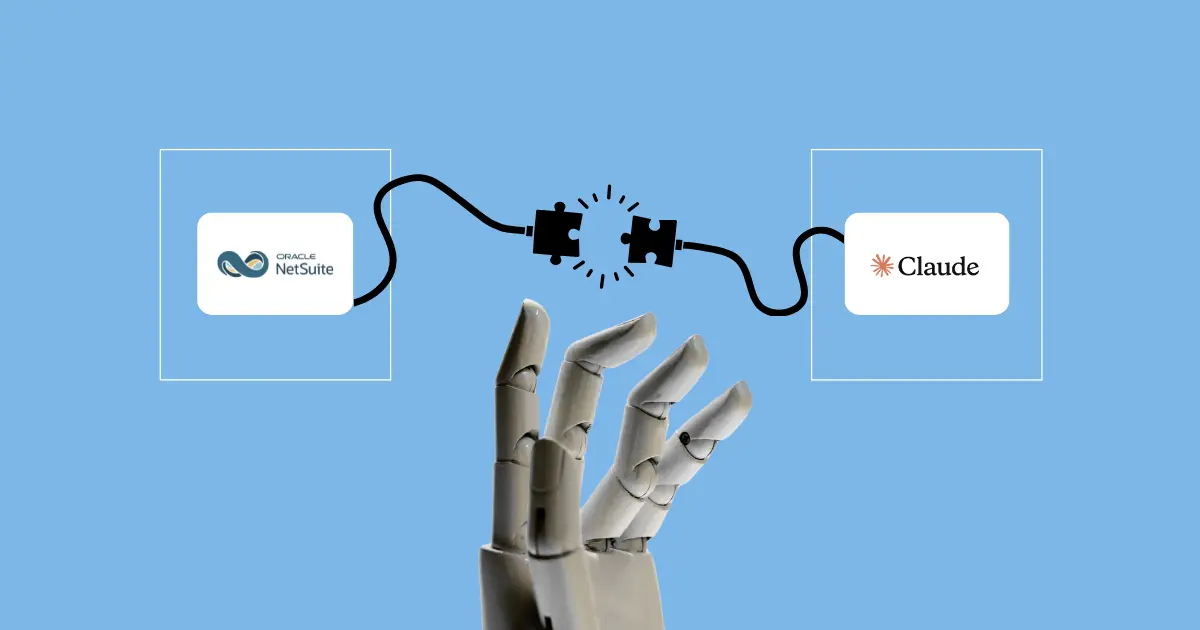
This is where the combination of Claude AI and NetSuite APIs introduces a new opportunity. Rather than adding more dashboards or complex workflows, it creates an intelligent layer that can interpret ERP data, highlight patterns, and surface insights in a way that helps organizations act sooner and with greater clarity.
Why Traditional ERP Automation Is No Longer Enough
ERP automation has historically focused on executing predefined rules — approvals, scheduled reports, and structured workflows. These capabilities remain essential because they ensure process consistency and transactional control. However, they are designed for repeatable tasks, not for interpreting complex business signals.
For example:
A workflow can approve a purchase order.
A report can show revenue variance.
A saved search can list inventory shortages.
But none of these explain why the variance is happening, what patterns are emerging, or where leadership should focus next.
By enabling Claude AI for NetSuite through APIs, organizations extend automation into areas that previously required manual interpretation. Instead of simply moving data from one place to another, AI can analyze, correlate, and summarize information across modules.
This represents a shift from task-based automation to insight-driven operations.
What Claude AI Adds to the NetSuite Environment
Using Claude alongside NetSuite does not change the ERP’s role as the system of record. NetSuite continues to manage financial integrity, operational control, and transactional accuracy.
Through our NetSuite AI Connector Service, Claude acts as a complementary intelligence layer—securely connecting with NetSuite to interpret the data already within the system and make it more accessible for analysis, insights, and faster decision-making without altering core ERP processes.
Through structured API access, Claude can:
Read and analyze ERP data securely
Identify relationships across financial and operational datasets
Translate structured records into business-level insights
Provide contextual explanations instead of static outputs
This approach allows organizations to interact with their ERP data more dynamically, asking questions, exploring trends, and receiving contextual answers without relying entirely on technical resources.
High-Impact Use Cases for Claude AI with NetSuite
While the ability to update records exists, the real value of a Claude NetSuite integration lies in business intelligence, analysis, and decision support.
1. Cash Flow Monitoring and Visualization
Cash flow visibility is critical, yet many organizations rely on periodic reports or spreadsheet consolidation.
With Claude connected to NetSuite:
Finance leaders can request real-time summaries of inflows and outflows.
AI can interpret trends rather than just present balances.
Visual dashboards can be generated dynamically to illustrate liquidity patterns.
This allows organizations to move from retrospective cash reporting to continuous financial awareness.
2. Trend Analysis and Year-Over-Year Comparisons
Analyzing long-term trends across inventory, revenue, or procurement often requires manual work from analysts.
Using Claude AI NetSuite integration, organizations can:
Compare year-over-year operational metrics instantly.
Drill into variances across locations, products, or business units.
Identify emerging demand or cost patterns earlier.
Instead of building complex reports, teams can refine insights through guided analysis.
3. Simplifying Complex Saved Searches
Building advanced saved searches in NetSuite can be time-consuming, especially when joins and transaction logic are involved.
Claude can assist by:
Recommending the correct search structure.
Identifying required fields and relationships.
Explaining how to configure queries for accurate results.
This turns AI into a functional advisor, helping teams navigate ERP complexity more efficiently.
4. Exception Detection Across Transactions
Manual review of transactions often identifies issues too late.
Claude can analyze transaction patterns to surface:
Unusual purchasing behavior
Margin inconsistencies
Operational bottlenecks
Data anomalies requiring review
This proactive visibility allows teams to focus on meaningful exceptions rather than reviewing routine activity.
5. Cross-Functional Insight Without Manual Consolidation
ERP data spans finance, operations, sales, and supply chain, but insights are often siloed.
A NetSuite Claude connector can interpret data across modules simultaneously, delivering unified insights that support coordinated decision-making.
6. Revenue Leakage Identification
Revenue erosion rarely comes from one obvious issue. It often results from small inefficiencies — pricing inconsistencies, delayed billing, unbilled services, or contract misalignment.
Claude can analyze NetSuite transaction data to:
Identify gaps between fulfilled orders and invoices
Detect pricing deviations across customers or regions
Highlight missed billing opportunities
Surface trends in discounting behavior
This allows finance and operations teams to address revenue leakage proactively rather than discovering it during audits.
7. Procurement Optimization and Vendor Performance Analysis
Procurement teams manage large volumes of purchasing data but often lack time to analyze vendor performance in depth.
Claude can evaluate:
Vendor lead-time variability
Cost fluctuations across purchase cycles
Supplier reliability trends
Opportunities for vendor consolidation
By interpreting NetSuite purchasing data, organizations gain actionable insights into supplier relationships instead of relying solely on historical averages.
8. Inventory Risk and Demand Signal Detection
Inventory challenges typically emerge gradually — excess stock in one category and shortages in another.
Claude can monitor NetSuite inventory movements and:
Highlight slow-moving or aging inventory
Detect unexpected demand spikes
Recommend areas for rebalancing stock
Identify patterns causing stockouts
This helps organizations shift from reactive inventory management to predictive planning.
9. Faster Period-End Reviews and Close Readiness Insights
While NetSuite manages the financial close process effectively, leadership often needs quick visibility into what requires attention before close is finalized.
Claude can summarize:
Outstanding reconciliations
Unusual journal activity
Variances requiring review
Departments contributing to delays
This provides a clearer operational picture during time-sensitive financial cycles.
10. Customer Behavior and Profitability Insights
Customer data within NetSuite often remains underutilized beyond transactional reporting.
Claude can interpret:
Profitability by customer segment
Order frequency changes
Margin trends tied to fulfillment patterns
Customers driving disproportionate operational effort
This enables organizations to align sales, service, and operational strategies with actual performance data.
11. Internal Knowledge Assistance for NetSuite Users
Many NetSuite users depend on internal experts to answer functional questions or explain system behavior.
Claude can act as a contextual assistant by:
Explaining transaction relationships
Guiding users on how specific data is structured
Helping teams understand how to interpret system outputs
Reducing reliance on internal “power users”
This improves productivity without altering existing workflows.
12. Scenario Exploration and What-If Analysis
Decision-makers often want to test assumptions but lack time to model scenarios manually.
Claude can analyze historical NetSuite data to support questions such as:
What happens if procurement costs rise by a certain percentage?
How would margin shift under different sales patterns?
Which cost centers are most sensitive to demand changes?
This helps leadership explore possibilities using existing ERP data without building complex models.
Strategic Benefits of Combining NetSuite and Claude AI
Organizations exploring NetSuite and Claude together are not simply trying to automate tasks — they are looking to improve how decisions are informed.
- Faster Insight Generation : AI reduces the time between data creation and understanding, helping leadership respond more quickly to operational changes.
- Reduced Dependence on Manual Reporting: Teams spend less time extracting and preparing data, allowing them to focus on evaluating outcomes and strategies.
- Better Use of Existing ERP Investments: Most organizations already possess the data needed to drive smarter decisions. AI helps unlock its full value.
- Scalable Intelligence Without Expanding Teams: As businesses grow, the volume of ERP data increases. AI provides analytical scalability without adding reporting overhead.
- Improved Visibility Into Emerging Risks and Opportunities: AI-driven interpretation helps surface patterns earlier than traditional analysis methods.
The Future: From ERP as a Record System to ERP as an Intelligence Source
ERP platforms have always centralized business information. What is changing now is how that information can be used.
By combining Claude AI with NetSuite APIs, organizations can move from retrospective reporting toward continuous understanding — gaining the ability to interpret signals earlier, respond more confidently, and operate with greater agility.
This evolution does not replace NetSuite.
It extends its value by making the data it already manages more actionable.
Final Thoughts
The conversation around AI in NetSuite ERP is no longer about automation alone. It is about enabling systems to help interpret the business environment they already record.
Organizations that successfully align Claude AI with NetSuite are not adding another tool they are creating a smarter operational layer that helps translate data into direction.