Choosing the right ERP (Enterprise Resource Planning) system is one of the most critical decisions a business can make. The right ERP can streamline operations, improve financial visibility, and support long-term growth. On the other hand, the wrong choice can lead to high costs, complex implementations, and limited scalability.Two of the most popular cloud-based ERP systems in the market today are NetSuite and Acumatica. Both target growing and mid-market businesses but differ significantly in features, deployment models, pricing, and scalability.This blog provides a detailed, side-by-side comparison of NetSuite vs Acumatica so decision makers, CEOs, CFOs, and operations leaders can make an informed choice based on their company’s unique requirements.
What is NetSuite?
NetSuite, owned by Oracle, is one of the first and most widely adopted cloud ERP solutions in the world. It serves more than 37,000 organizations across 200+ countries and is known for its scalability and global business management capabilities.- Target Market: Mid-sized to large businesses, global enterprises, and fast-growing companies.
- Core Strength: End-to-end ERP suite covering finance, supply chain, CRM, HR, eCommerce, and more within a single system.
- Deployment: 100% cloud-native (no on-premise option).
- Key Differentiator: Strong financial management, global compliance support (multi-subsidiary, multi-currency, multi-language), and advanced modules for almost every industry.
In short, NetSuite is designed for businesses that want a unified, highly scalable ERP with global capabilities.What is Acumatica?
Acumatica is a younger but fast-growing ERP provider founded in 2008. Unlike NetSuite, Acumatica is not owned by a large corporation but has positioned itself as a flexible and cost-effective alternative for small to mid-market businesses.- Target Market: SMBs and mid-market businesses that want flexibility and control over deployment.
- Core Strength: Flexible licensing model, modern interface, and strong industry editions (Construction, Distribution, Manufacturing, Retail/Commerce).
- Deployment: Cloud-based but with options for private cloud or on-premise—giving businesses more control.
- Key Differentiator: User-based pricing does not apply. Instead, Acumatica charges based on resource usage, which can be attractive for businesses with many occasional users.
Acumatica appeals to mid-sized businesses that want ERP flexibility, modern functionality, and lower upfront cost compared to larger players like NetSuite.Detailed Features Comparison: Acumatica vs NetSuite
Below is a focused, easy-to-scan features comparison designed for business owners and decision makers.
First you’ll see a one-page overview table to orient the team, then a clear, plain-English deep dive for each feature area with a short decision signal and a real-world example where helpful.
1. Core Finance & Accounting
NetSuite
NetSuite provides an enterprise-grade General Ledger, fully integrated with Accounts Payable, Accounts Receivable, Fixed Assets, and Cash Management. It supports multi-subsidiary and multi-currency operations with automated intercompany eliminations. Advanced reporting and dashboards allow CFOs and finance teams to consolidate global financials quickly. The system also supports multi-GAAP and IFRS reporting and includes pre-configured compliance packs for audit trails and regulatory requirements.Acumatica
Acumatica offers a flexible General Ledger with multiple charts of accounts and project/job-level accounting. Its AP/AR modules are tightly integrated with project costing and allocations. Fixed asset management is included, and accounting processes are easier to configure for mid-market or project-focused companies. Consolidation for multi-entity setups is supported but often requires partner assistance for complex international operations.Comparison Table:
| Feature | NetSuite | Acumatica |
|---|
| General Ledger | Enterprise-grade, multi-GAAP/IFRS, automated intercompany | Flexible, multi-chart, project/job-level accounting |
| Accounts Payable / Receivable | Automated, multi-currency, intercompany AP/AR | Integrated with project/job accounting |
| Fixed Assets | Automated depreciation, revaluation, multi-currency support | Depreciation and asset tracking, manual setup |
| Consolidation | Automatic intercompany eliminations, multi-subsidiary | Supported, may require partner setup |
| Compliance & Audit | Pre-configured packs, audit trails | Available, depends on hosting and setup |
2. Multi-Entity & Tax
NetSuite
NetSuite OneWorld allows multi-subsidiary, multi-currency, and multi-tax configurations. It automates intercompany transactions and offers country-specific tax localizations and reports. This makes it ideal for global enterprises managing complex tax and legal entity requirements.Acumatica
Acumatica supports multiple companies and intercompany transactions. Tax handling is flexible but often relies on partner modules or custom configurations for local tax compliance. Deployment flexibility allows integration with regional tax engines if needed.Comparison Table:
| Feature | NetSuite | Acumatica |
|---|
| Multi-company support | Unlimited subsidiaries, intercompany automation | Multiple companies, may require partner assistance |
| Tax handling | Country-specific tax packs, automated calculations | Flexible, often requires partner setup |
| Currency management | Multi-currency with automatic conversion | Multi-currency supported |
| Intercompany transactions | Fully automated | Supported, may need setup |
3. Revenue & Subscription Billing
NetSuite
NetSuite’s Advanced Revenue Management (ARM) module handles complex revenue recognition and subscription billing. It automates ASC 606 compliance, multi-element arrangements, deferred revenue, and multi-currency billing. The system integrates tightly with order-to-cash, CRM, and finance modules, providing real-time visibility into recurring revenue streams and financial impact.Acumatica
Acumatica supports recurring billing and subscription management, including progress billing and contract-based invoicing. Revenue recognition can be configured, but advanced multi-element or automated ASC 606 compliance usually requires partner solutions or custom configuration. Integration with project accounting allows alignment of billing with project costs.Comparison Table:
| Feature | NetSuite | Acumatica |
|---|
| Revenue recognition | Automated, ASC 606 compliant, multi-element support | Configurable, may need partner/customization |
| Subscription billing | Supports multiple billing schedules, automated invoicing | Recurring billing, progress invoicing |
| Multi-currency billing | Fully supported | Supported |
| Integration with finance & CRM | Fully integrated | Integrated with project accounting; CRM via connectors |
4. Inventory, WMS & Fulfillment
NetSuite
NetSuite offers advanced inventory management and warehouse capabilities. It supports multi-location inventory, lot and serial tracking, bin management, cycle counts, and automated reorder points. NetSuite’s WMS integrates with eCommerce and 3PL systems, enabling real-time inventory visibility across channels.Acumatica
Acumatica provides inventory management for mid-market businesses, including multi-location support, lot and serial tracking, and basic warehouse processes. It integrates with external eCommerce and logistics solutions. Advanced WMS features are available through add-ons or partner solutions.Comparison Table:
| Feature | NetSuite | Acumatica |
|---|
| Multi-location inventory | Yes, fully integrated | Yes |
| WMS functionality | Advanced, native, cycle counts, automated workflows | Mid-market WMS, basic workflows |
| Lot/serial tracking | Supported | Supported |
| eCommerce & 3PL integration | Native integration | Via connectors/add-ons |
5. Manufacturing & MRP
NetSuite
NetSuite offers robust manufacturing capabilities, including MRP, demand planning, production scheduling, BOM and routing management, and capacity planning. It supports multi-site production and integrates with inventory, supply chain, and finance modules.Acumatica
Acumatica provides manufacturing functionality tailored for job-shop and make-to-order environments. It includes BOM, routing, work orders, scheduling, and shop-floor tracking. The platform is well-suited for mid-market manufacturers seeking operational flexibility.Comparison Table:
| Feature | NetSuite | Acumatica |
|---|
| Production planning | Advanced MRP, multi-site | Job-shop & make-to-order focus |
| BOM & routing | Supported | Supported |
| Shop-floor tracking | Supported | Strong mobile/field tracking |
| Demand planning | Advanced forecasting | Basic planning |
6. Project Accounting & Job Costing
NetSuite
NetSuite provides strong project accounting capabilities suitable for professional services organizations. Features include time and expense tracking, project budgeting, resource allocation, billing and invoicing, and revenue recognition. The system allows integration with finance, CRM, and billing modules to provide real-time project profitability insights.Acumatica
Acumatica excels in construction and project-driven industries. Its job-costing and project accounting modules include progress billing, commitment tracking, change orders, and mobile field entry for time and expense. The system allows tight integration between project costs and revenue, providing operational control over each job.Comparison Table:
| Feature | NetSuite | Acumatica |
|---|
| Time & expense tracking | Supported | Supported, mobile field entry |
| Project budgeting | Advanced, integrated | Supported, flexible |
| Billing & invoicing | Integrated with finance & CRM | Progress billing & contract invoicing |
| Revenue recognition | Supported, automated | Configurable, may need customization |
| Job costing | Integrated with accounting | Strong job-costing features |
7. CRM & Commerce
NetSuite
NetSuite provides native CRM integrated with the ERP. Features include lead management, opportunity tracking, sales forecasting, customer support, and marketing automation. SuiteCommerce provides a fully integrated eCommerce solution for B2B and B2C businesses, reducing the need for separate systems or connectors.Acumatica
Acumatica includes a CRM module with lead, opportunity, and customer management. Ecommerce is typically implemented via connectors to platforms like Shopify or BigCommerce. Sales and customer data can integrate with the ERP, but it may require additional configuration for unified workflows.Comparison Table:
| Feature | NetSuite | Acumatica |
|---|
| CRM functionality | Native, fully integrated | Native, integrated with ERP |
| Sales order management | Fully integrated | Supported, may require configuration |
| eCommerce | Native SuiteCommerce | Via connectors |
| Marketing automation | Integrated | Limited, may require add-ons |
8. Reporting & Analytics
NetSuite
NetSuite offers SuiteAnalytics for real-time dashboards, saved searches, and workbook analytics. Advanced users can leverage SuiteAnalytics Warehouse for data warehousing and BI integration, allowing enterprise-wide reporting and advanced visualization across multiple subsidiaries and data sources.Acumatica
Acumatica provides robust operational dashboards and reporting tools. Data can be accessed via OData or REST endpoints, making it easy to integrate with Power BI or Excel for advanced analytics. Reports are highly customizable and allow real-time visibility into operational KPIs.Comparison Table:
| Feature | NetSuite | Acumatica |
|---|
| Dashboards | Real-time, role-based | Real-time, customizable |
| Ad-hoc reporting | SuiteAnalytics saved searches/workbooks | Custom reports via OData/Excel/Power BI |
| BI & data warehousing | SuiteAnalytics Warehouse | External BI via connectors |
| KPI monitoring | Built-in | Built-in |
9. Customization & APIs
NetSuite
NetSuite provides a comprehensive customization framework via SuiteCloud, which includes SuiteScript (JavaScript), SuiteFlow (workflow automation), and SuiteTalk (SOAP/REST APIs). Businesses can create custom fields, forms, workflows, and scripts, and leverage a large SuiteApp marketplace for pre-built integrations. This makes NetSuite highly extensible for complex enterprise needs.Acumatica
Acumatica is built on the xRP platform with .NET technology. It provides REST and SOAP APIs, OData endpoints, and configurable screens, dashboards, and workflows. Its open architecture allows developers to customize forms, modules, and integrations efficiently, especially for organizations with .NET development teams.Comparison Table:
| Feature | NetSuite | Acumatica |
|---|
| Platform | SuiteCloud (JavaScript, workflows, SuiteApps) | xRP (.NET) |
| APIs | SuiteTalk (SOAP/REST), SuiteScript | REST/SOAP APIs, OData |
| Workflows | SuiteFlow | Configurable workflows |
| Marketplace / pre-built integrations | Large SuiteApp ecosystem | Growing partner/connector network |
10. Deployment & Security
NetSuite
NetSuite is a 100% cloud-native SaaS platform. Upgrades are managed by Oracle, typically twice per year. Security is handled centrally with enterprise-grade controls, including SOC and ISO certifications, encryption, and multi-factor authentication. Data residency and compliance are standardized through the vendor’s infrastructure.Acumatica
Acumatica offers cloud-based deployment, private cloud, and hybrid options. Upgrades can be managed by the customer or partner depending on deployment choice. Security depends on hosting: SaaS inherits cloud provider certifications, while private deployments require customer-managed compliance. It provides encryption, role-based access, and audit trails.Comparison Table:
| Feature | NetSuite | Acumatica |
|---|
| Deployment options | SaaS only | SaaS, private cloud, hybrid |
| Upgrade management | Vendor-managed, twice yearly | Customer/partner managed |
| Security | Enterprise-grade, SOC/ISO certified | Cloud provider or customer managed |
| Data residency | Standardized | Flexible depending on hosting |
11. Ecosystem & Partner Network
NetSuite
NetSuite has a large global partner ecosystem and extensive ISV marketplace. Certified consultants and developers are widely available, enabling faster implementation, industry-specific configurations, and support. Its SuiteApp ecosystem covers CRM, commerce, industry modules, and integrations.Acumatica
Acumatica has a growing partner network, strong in North America and regional markets. It supports industry-specific editions and provides integrations via partners. While smaller than NetSuite’s global ecosystem, it offers focused expertise for mid-market businesses and niche industries.Comparison Table:
| Feature | NetSuite | Acumatica |
|---|
| Partner network | Large, global | Growing, regional |
| ISV marketplace | Extensive SuiteApps | Limited, partner-driven |
| Industry support | Wide, enterprise-grade | Strong mid-market editions |
| Talent availability | Large pool of consultants/developers | Smaller pool, focused |
Pricing Model & Implementation Cost: NetSuite vs Acumatica
NetSuite
- Subscription-based SaaS pricing: Typically consists of a base ERP license + per-user fees.
- Base license: Around $999–$1,000/month (for core ERP).
- User fees: Around $99–$149/user/month, depending on role (full access vs limited).
- Modules/add-ons: CRM, WMS, Advanced Revenue Management, SuiteCommerce, and other industry-specific modules usually incur additional fees.
- Implementation costs: Can vary from $25,000 (small mid-market) to $250,000+ for enterprise deployments depending on complexity, customization, and integration needs.
- Annual maintenance / support: Included in subscription, though premium support levels may cost extra.
Read More: See our full guide for a detailed look at the NetSuite pricing.
Acumatica
- Resource-based pricing: Unlike user-based pricing, Acumatica charges based on “functional resources” (e.g., transaction volume, database size, or module usage).
- Modules: Licensing depends on which modules you implement (Financials, Distribution, Manufacturing, Construction, CRM).
- Deployment options: SaaS, private cloud, or on-premise; infrastructure may affect total cost.
- Implementation costs: Typically lower than NetSuite for mid-market deployments ($15,000–$150,000) due to flexible deployment and simpler configuration.
- Annual maintenance / support: Usually included in subscription or hosting; partner-provided support may vary.
Pros and Cons: NetSuite vs Acumatica
NetSuite Pros:
- Enterprise-grade, scalable for global operations
- Advanced financial automation and reporting
- Integrated modules across finance, CRM, eCommerce, WMS, and more
- Large partner ecosystem and SuiteApp marketplace
- Strong compliance and audit capabilities
NetSuite Cons:
- Higher total cost of ownership, especially with multiple modules and users
- Steeper learning curve for new users
- Customization and implementation can be complex
Acumatica Pros:
- Flexible deployment (SaaS, private cloud, hybrid)
- Resource-based pricing and unlimited user access
- Strong project/job accounting and manufacturing support
- User-friendly interface and easier implementation
- Good mid-market and niche industry support
Acumatica Cons:
- Smaller global partner network
- Some advanced modules or compliance features may require add-ons or partner support
- Multi-entity consolidation and enterprise-level automation less robust than NetSuite
G2 User Reviews: NetSuite vs. Acumatica
NetSuite
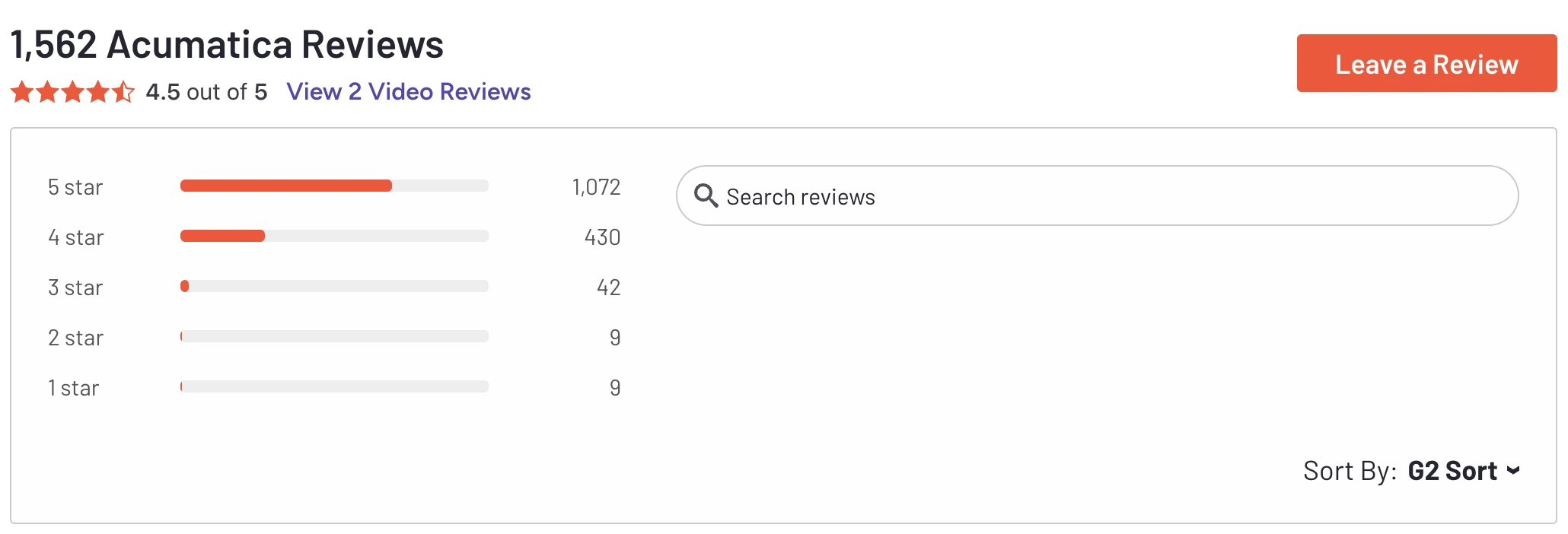
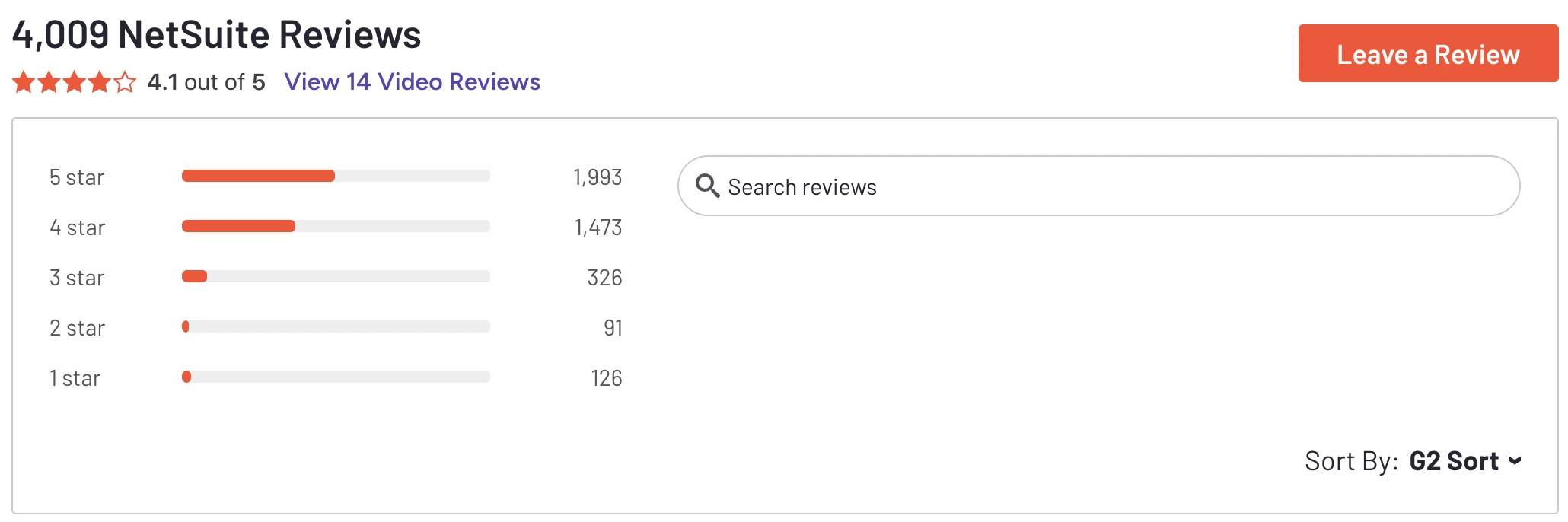
Users on G2 appreciate NetSuite’s robust features for revenue management and financial reporting. One reviewer highlighted its seamless flow from sales orders to invoicing, praising the system’s user-friendliness and customizable reports. Acumatica
 is lauded for its intuitive interface and comprehensive functionality on. A reviewer on G2 with 20 years in accounting noted discovering new modules even after four years of daily use, emphasizing its user-friendly design and extensive capabilities.
Acumatica
Acumatica is lauded for its intuitive interface and comprehensive functionality on. A reviewer on G2 with 20 years in accounting noted discovering new modules even after four years of daily use, emphasizing its user-friendly design and extensive capabilities.Which One Should You Choose?
Choose NetSuite if you:
- Operate across multiple countries or subsidiaries
- Require advanced finance automation and consolidated reporting
- Need enterprise-grade modules and a large partner ecosystem
- Have a higher budget and complex operational requirements
Choose Acumatica if you:
- Are a mid-market company or project-driven business
- Prefer flexible deployment options (SaaS, private cloud, or hybrid)
- Want unlimited user access and lower TCO
- Need strong project/job accounting with easier implementation
Conclusion
Both NetSuite and Acumatica are strong ERP platforms, but they serve different business needs. NetSuite excels for large, complex, global operations that require advanced automation and scalability. Acumatica is ideal for mid-market companies seeking flexibility, lower total cost of ownership, and strong project or job accounting capabilities.




 Acumatica
 is lauded for its intuitive interface and comprehensive functionality on. A reviewer on G2 with 20 years in accounting noted discovering new modules even after four years of daily use, emphasizing its user-friendly design and extensive capabilities.
Acumatica
Acumatica is lauded for its intuitive interface and comprehensive functionality on. A reviewer on G2 with 20 years in accounting noted discovering new modules even after four years of daily use, emphasizing its user-friendly design and extensive capabilities.