




Get In Touch
Our customer support team is available for help.
Let's Talk Business!
© Copyright 2026 @ ERP Peers


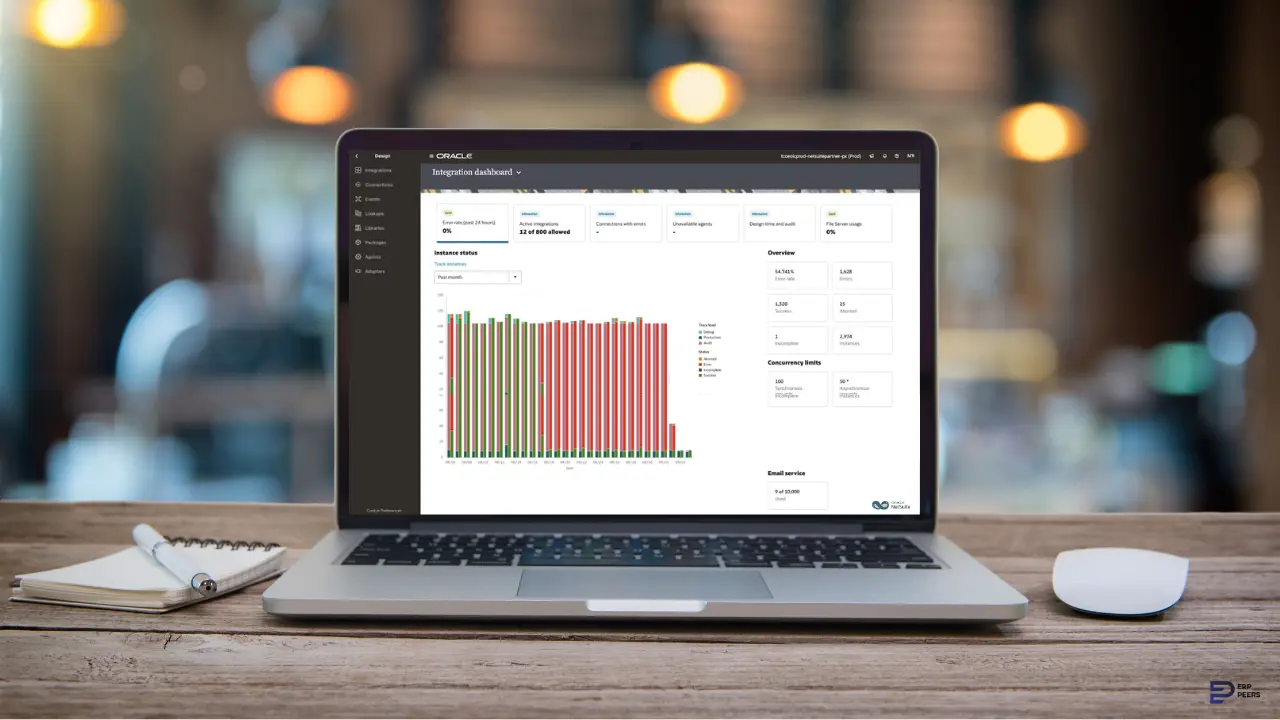
Modern enterprises rarely operate on a single system. Finance may run in ERP, sales in CRM, logistics in third party applications, and analytics in specialized platforms. The real value is not created by these systems individually, but by how effectively they communicate with each other. This is where the NetSuite Integration Platform, commonly referred to as NSIP, becomes a strategic enabler rather than just a technical tool.
Organizations using Oracle NetSuite often reach a stage where growth introduces complexity. New subsidiaries, ecommerce channels, billing tools, procurement systems, and data platforms must integrate seamlessly. NSIP provides the architecture to make those integrations structured, scalable, and governable.
NSIP is the framework and set of technologies that allow NetSuite to connect with external systems, automate data exchange, and orchestrate business processes across applications. It is not a single connector or plugin. Instead, it is an integration ecosystem built on APIs, middleware compatibility, event driven communication, and secure data handling.
In practical terms, NSIP allows organizations to treat NetSuite as the operational core while enabling other applications to interact with it in real time or through controlled synchronization. Rather than building isolated point to point integrations, NSIP promotes a reusable and scalable integration model.
This distinction becomes critical as businesses expand. Direct integrations may work for two or three systems, but they quickly become fragile when dozens of workflows must remain aligned across regions and business units.
As companies scale, integration challenges shift from technical connectivity to operational reliability.
Data duplication begins to impact reporting accuracy.
Manual reconciliation increases finance workload.
Disconnected workflows slow order fulfillment and customer response times.
Security and compliance risks grow when integrations are unmanaged.
NSIP addresses these issues by introducing governance, visibility, and consistency into how systems exchange information. Instead of asking whether systems can connect, organizations begin to control how they should connect through standardized NetSuite Integration Services frameworks.
NSIP is designed to support enterprise grade integration requirements while remaining flexible enough for evolving business models.
API First Architecture : NetSuite’s REST and SOAP APIs enable secure and standardized communication with external applications. This allows integrations to be version controlled, documented, and scalable.
Event Driven Processing: NSIP supports triggering actions based on business events such as order creation, invoice approval, or inventory updates. This enables near real time synchronization without constant polling.
Middleware Compatibility: The platform integrates seamlessly with leading iPaaS solutions such as Celigo, MuleSoft, and Boomi, allowing organizations to implement Celigo, Mulesoft, or Boomi for NetSuite Integration depending on their architecture and scalability needs.
Custom Workflow Enablement: SuiteScript and SuiteTalk capabilities allow organizations to tailor integrations to their operational logic instead of forcing processes to match software limitations.
Security and Role Based Access: Authentication protocols, token based access, and permission control ensure integrations align with enterprise security standards.
Scalable Data Handling: Batch processing and asynchronous communication allow high transaction volumes without degrading system performance.
Integration today is no longer only about moving data. It is about interpreting and acting on that data intelligently.
AI introduces a new layer of value within NSIP environments by transforming integrations into decision enabling systems. Instead of simply syncing records, AI can identify anomalies, recommend actions, and automate responses based on historical patterns.
Examples of AI driven integration use include intelligent invoice matching that flags discrepancies automatically, predictive inventory synchronization that adjusts supply signals across systems, and automated data classification that reduces manual intervention during high volume transactions.
AI does not replace ERP governance. It enhances it by making integrated data more actionable, contextual, and timely.
Organizations that implement NSIP strategically experience measurable improvements beyond IT efficiency.
Operational Alignment Across Systems
Departments work from consistent data, reducing reconciliation cycles and eliminating conflicting reports.
Faster Process Execution
Orders, billing, fulfillment, and financial updates move automatically between platforms, accelerating business throughput.
Reduced Integration Maintenance Costs
A structured integration model avoids rebuilding connections whenever a new application is introduced.
Improved Data Accuracy and Visibility
Centralized governance ensures that data transformations follow defined rules, improving auditability and trust.
Scalability for Expansion
Whether entering new markets, acquiring entities, or launching digital channels, integrations scale without redesigning the architecture.
Enhanced Compliance and Control
Standardized integration policies help maintain regulatory and financial integrity across systems.
The cost of adopting NSIP is influenced more by integration design than by licensing alone. Organizations should evaluate investment across three dimensions.
Integration Complexity
Simple integrations between NetSuite and a single CRM require limited effort, while multi system orchestration across ecommerce, logistics, and finance demands deeper architecture planning.
Middleware and Infrastructure Choices
Using an integration platform as a service adds scalability but introduces subscription costs. Direct API integrations reduce licensing expenses but require stronger internal governance.
Customization and Business Logic Requirements
Highly tailored workflows, data transformations, or regional compliance rules may increase implementation effort but deliver long term operational precision.
Ongoing Optimization
Integration is not a one time activity. Monitoring, scaling, and enhancing integrations ensure they continue to support evolving business models.
When evaluated correctly, NSIP is not an IT expense. It is an operational investment that reduces long term system fragmentation costs.
Organizations that treat integration as infrastructure rather than customization achieve significantly greater resilience.
Digital transformation often focuses on adopting new applications, but transformation truly succeeds when those applications operate as a unified ecosystem.
NSIP enables NetSuite to function as the financial and operational backbone while allowing innovation to occur around it. Businesses can adopt new technologies, AI tools, customer platforms, or analytics solutions without disrupting core processes.
This balance between stability and flexibility is what allows enterprises to modernize without losing control.

Final Thoughts
The NetSuite Integration Platform is not simply a technical layer. It is the mechanism that allows ERP to scale alongside the business it supports. As organizations expand across systems, geographies, and digital channels, NSIP ensures that data, processes, and intelligence remain connected.
By leveraging structured NetSuite Integration partner and modern middleware approaches such as Celigo for NetSuite integration, Mulesoft, organizations can create an ecosystem that is connected, intelligent, and ready for growth.
Companies that invest in structured integration today position themselves to adopt AI, automation, and future technologies with far less disruption tomorrow. In a landscape where operational speed and accuracy define competitiveness, NSIP becomes a strategic necessity rather than an optional capability.
Our customer support team is available for help.