For businesses leveraging NetSuite, seamless integration with other systems is crucial for optimizing workflows, automating processes, and enhancing operational efficiency. NetSuite API Integration
enables companies to connect NetSuite with CRMs, e-commerce platforms, financial tools, and third-party applications, ensuring smooth data flow and real-time synchronization.If your integration needs fit a packaged connector rather than a custom API build, our Celigo integration services are usually the faster path — see our full NetSuite integration services overview for how we choose between the two. If you need ongoing development support rather than a one-off build, you can also hire a NetSuite developer from our team.
This guide provides expert-level insights into NetSuite’s API capabilities, customization strategies, and practical use cases for decision-makers like CEOs, CFOs, and IT leaders who want to maximize their NetSuite investment.
What is NetSuite API Integration?
API integration for NetSuite allows businesses to connect NetSuite with other software systems, enabling seamless data exchange and automation. Through APIs, NetSuite can communicate with CRMs, e-commerce platforms, payment gateways, and other third-party applications. Understanding NetSuite APIs: Types and Use Cases
NetSuite provides multiple APIs tailored for different integration scenarios. Understanding these APIs is essential for selecting the right approach for your business.1. SuiteTalk (SOAP API)
SuiteTalk is NetSuite’s SOAP-based web services API that enables secure and structured communication between NetSuite and external applications.- Best for: Enterprise-level integrations, structured data exchange
- Key Features:
- Supports CRUD operations (Create, Read, Update, Delete) on NetSuite records
- Uses XML-based SOAP requests for secure, structured transactions
- Ideal for integrating ERP with third-party financial systems, CRMs, and legacy software
Use Case: A multinational firm integrates NetSuite with SAP to synchronize financial data, automate journal entries, and ensure compliance with corporate governance policies.2. RESTlet (REST API)
RESTlet is a lightweight, REST-based API in NetSuite that allows developers to create custom REST endpoints for seamless data interaction.- Best for: Custom business logic, lightweight integrations
- Key Features:
- Uses RESTful principles, enabling faster and flexible data access
- Supports JavaScript based customization using SuiteScript
- Ideal for real-time integration with e-commerce platforms and cloud applications
Use Case: An online retailer connects NetSuite with Shopify via RESTlets to sync order details, inventory updates, and customer information in real-time, preventing overselling.3. SuiteScript (Server-Side API)
SuiteScript is a JavaScript-based API that enables deep customization of NetSuite, allowing automation, custom workflows, and UI enhancements.- Best for: Custom workflows, automation, and UI customization
- Key Features:
- JavaScript-based API allows for deep customization of NetSuite
- Supports Client Scripts, User Event Scripts, Scheduled Scripts, and Suitelets
- Best for automating internal processes and extending NetSuite’s native capabilities
Use Case: A company automates its approval workflow for purchase orders by developing a SuiteScript-based approval process that dynamically notifies managers and updates PO statuses.4. SuiteAnalytics Connect (ODBC & JDBC API)
SuiteAnalytics Connect provides ODBC and JDBC connectivity, allowing direct access to NetSuite data for advanced reporting and analytics.- Best for: Advanced data analytics and reporting
- Key Features:
- Allows direct SQL queries on NetSuite data
- Best suited for BI tools like Power BI, Tableau, and custom dashboards
- Enables data warehousing and predictive analytics
Use Case: A CFO integrates SuiteAnalytics with Tableau to create a real-time financial dashboard, enabling data-driven decision-making across multiple subsidiaries.Selecting the Right NetSuite API: A Quick Comparison
| API Type | Best For | Key Features | Example Use Case |
|---|
| SuiteTalk (SOAP) | Enterprise Integration | Structured XML-based API, Secure | Integrating NetSuite with SAP for finance operations |
| RESTlets (REST) | Real-time Sync | JavaScript-based, Lightweight | Syncing Shopify orders with NetSuite inventory |
| SuiteScript | Custom Workflows | JavaScript Automation | Automating approval processes for purchase orders |
| SuiteAnalytics Connect | Data Analysis | SQL-based queries | Generating financial reports in Tableau |
NetSuite API Integration Strategies
To ensure successful integration, businesses need a well-structured approach. Here are key strategies:1. Direct API Integration vs. Middleware (iPaaS Solutions)
- Direct API Integration: Best for companies with in-house developers who can manage and maintain API connections.
- Middleware Solutions (Celigo, Boomi, Mulesoft): Ideal for businesses that need pre-built connectors and low-code integration tools.
Example: A business using multiple systems for sales, accounting, and inventory can implement pre-built Celigo NetSuite integration to automate data synchronization, eliminate manual data entry, and enhance operational efficiency across departments.2. Real-Time vs. Batch Processing
- Real-Time Integration: Best for e-commerce, inventory sync, and financial transactions.
- Batch Processing: More efficient for mass data updates and periodic reporting.
3. Handling NetSuite’s API Governance & Rate Limits
- Optimize API calls: Use bulk operations instead of multiple single-record updates.
- Leverage caching mechanisms: Minimize redundant API calls to improve performance.
- Use asynchronous processing: Schedule heavy operations during off-peak hours.
Security Best Practices for NetSuite API Integration
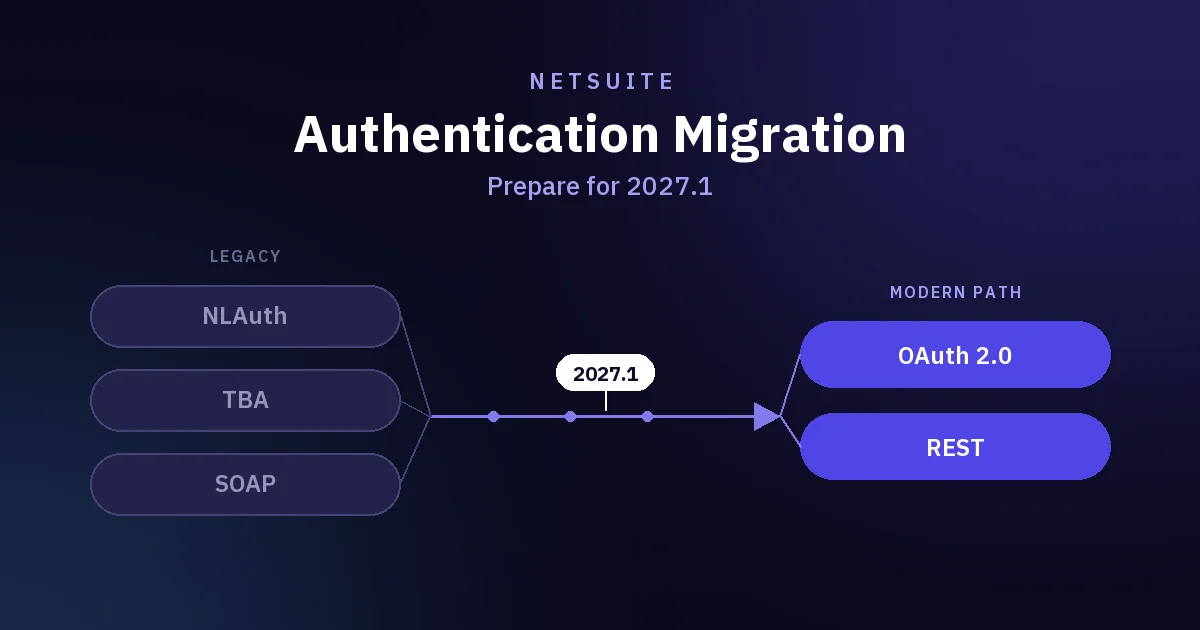
Security is a top priority when integrating NetSuite with other systems. Follow these best practices:- Use OAuth 2.0 for authentication to enhance security and reduce reliance on static credentials.
- Restrict API access with role-based permissions to prevent unauthorized data exposure.
- Monitor API usage logs to detect suspicious activity and prevent breaches.
- Encrypt sensitive data in transit and at rest for compliance with GDPR, HIPAA, and SOC2.
Common NetSuite API Integration Challenges & Solutions
| Challenge | Cause | Solution |
|---|
| Authentication Errors | Incorrect credentials or token expiration | Implement OAuth 2.0 with periodic token refresh |
| Data Mismatches | Inconsistent field mapping between systems | Ensure field validation before data transfer |
| API Rate Limits | Exceeding governance restrictions | Optimize batch processing and API request consolidation |
| Performance Issues | Large data volumes causing slow response | Use asynchronous APIs and caching mechanisms |
Future Trends in NetSuite API Integrations
- AI & Automation: Increased use of AI-driven automation for predictive analytics and workflow automation.
- GraphQL Adoption: A potential shift from REST to GraphQL for more efficient, flexible data querying.
- Low-Code & No-Code Integrations: Growing reliance on iPaaS solutions to reduce developer dependency.
- Enhanced Security Measures: Stronger compliance and data protection strategies in API integrations.

Conclusion
NetSuite API integration is a powerful tool for enhancing business efficiency, automation, and data synchronization. Whether integrating with CRM systems, financial tools, or e-commerce platforms, understanding NetSuite’s API capabilities and best practices ensures a smooth, secure, and scalable integration strategy.