


Get In Touch
Our customer support team is available for help.
NetSuite Implementation

A NetSuite implementation can pass dozens of happy-path tests and still fail at go-live. The missed problems usually sit at the boundaries: a role that cannot complete the real task, a rejected approval with no recovery path, an integration retry that creates a duplicate, a migration total that cannot be reconciled, or a temporary UAT permission that quietly becomes permanent.
This library gives implementation teams a structured starting point for testing those boundaries. It includes 101 adaptable test cases, a requirements traceability matrix, defect and execution logs, a role matrix, objective go/no-go gates, sign-off sheets and six reusable process diagrams.
These are sourced controls and reusable UAT patterns, not proof that any scenario works in a particular NetSuite account. Adapt every case to the configured features, roles, subsidiaries, workflows and integrations. Mark a case INSTANCE_VALIDATED only after it has been executed with retained evidence.
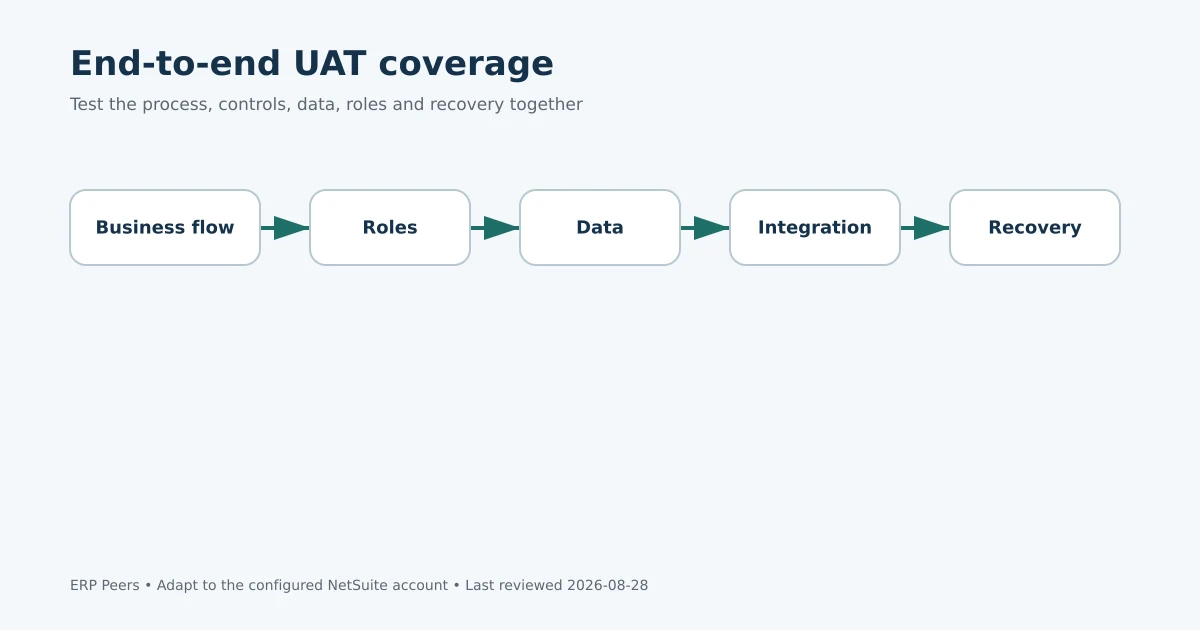
The test cases cover finance and period close, order to cash, procure to pay, inventory, revenue, roles and permissions, data migration, integrations, workflows, reporting, customizations, tax, cutover, negative and recovery paths, performance, audit evidence and post-go-live ownership.
ORACLE_DOCUMENTED_CONTROL identifies a control or testing principle supported by Oracle documentation. It does not mean Oracle wrote or validated the ERP Peers test steps.
ERP_PEERS_UAT_PATTERN identifies an adaptable practitioner-designed test pattern.
INSTANCE_VALIDATED is reserved for a case that was actually executed in the target account and has retained evidence. This release contains zero instance-validated cases.
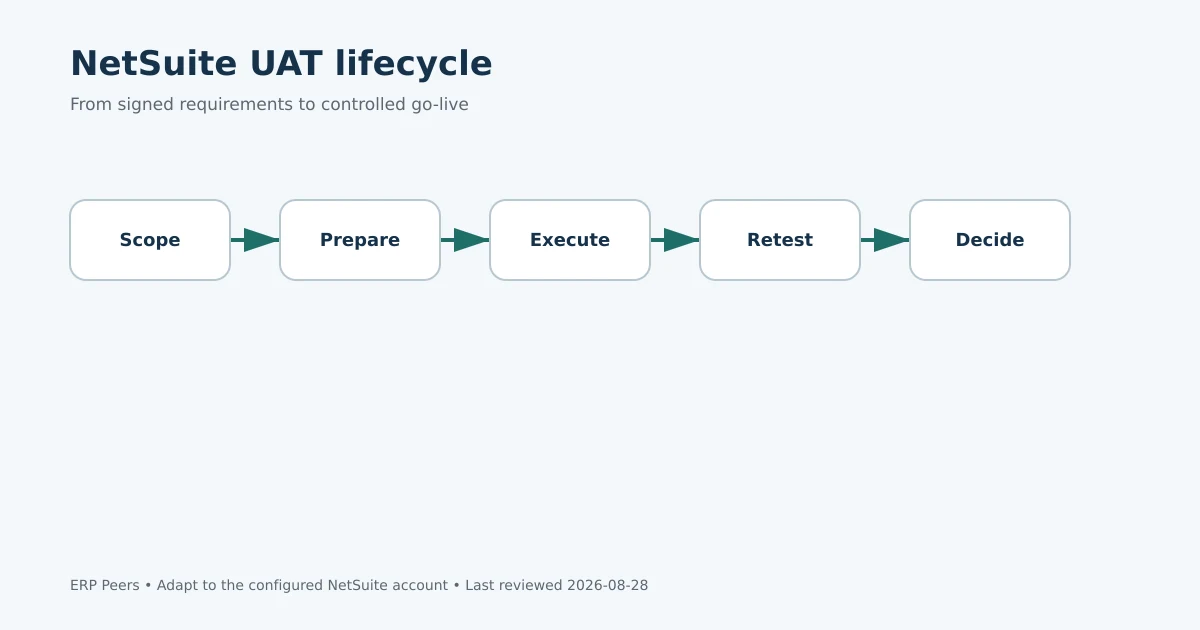
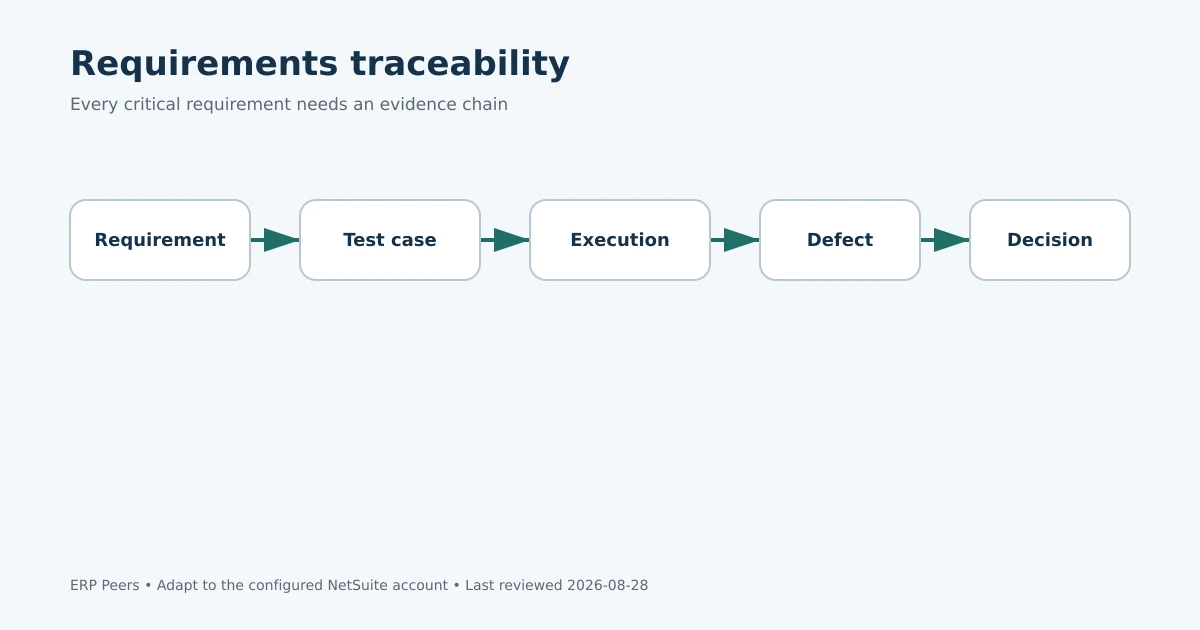
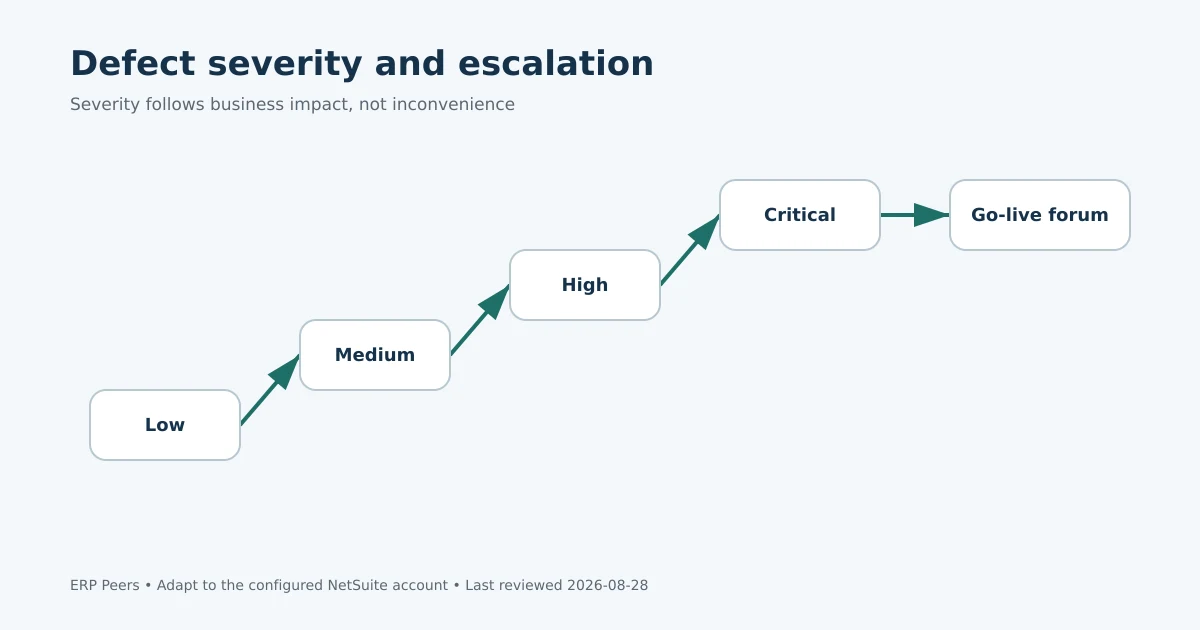
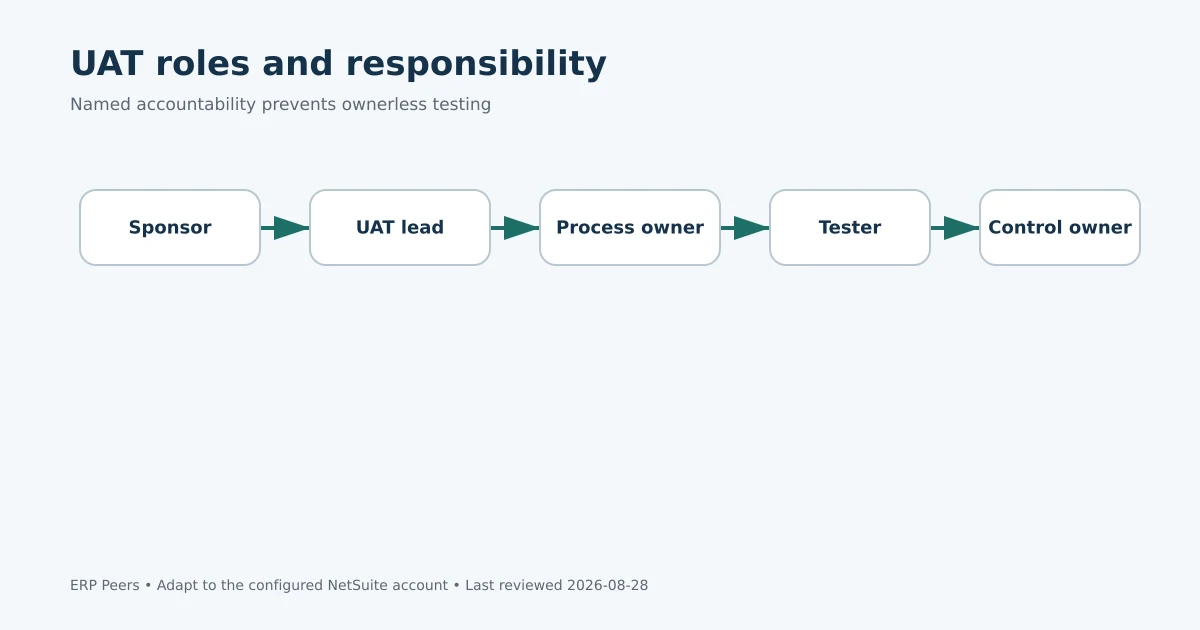
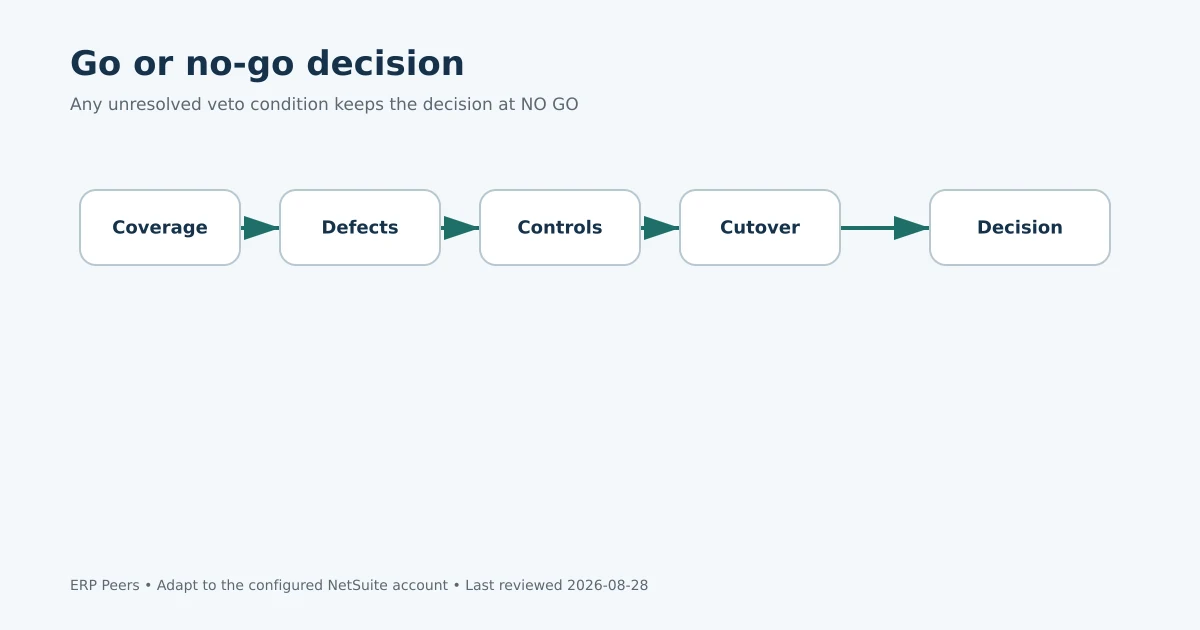
The toolkit includes the UAT lifecycle, requirements traceability, defect escalation, roles and responsibility, go/no-go decision and end-to-end coverage diagrams. Teams may reuse them with attribution and a link to this resource.
A trustworthy pass shows the user action, the role used, the record or message created, the expected-versus-actual comparison, the downstream effect, the evidence location and the reviewer. A screenshot of a saved record is not enough when the test is meant to prove GL posting, approval routing, integration delivery or duplicate prevention.
Do not approve go-live while a critical business process, data reconciliation, security boundary, integration recovery path or rollback dependency remains unproven. A risk can only be accepted by the accountable governance owner, with an explicit condition and follow-up owner. The workbook never converts a veto into GO automatically.
Review the library against both scheduled NetSuite releases, after major configuration changes, and before every material rollout. Oracle notes that NetSuite has two scheduled version upgrades each year, while other changes may arrive through monthly updates or SuiteApp releases.
ERP Peers can help turn signed requirements into an account-specific UAT plan, facilitate defect triage and prepare evidence-backed go-live gates. Scope, timing and outcomes depend on the implementation and cannot be guaranteed in advance.
Our customer support team is available for help.
Need help with NetSuite?
Chat with our team.